Exterior Paint LRV for Hot Southwest Florida Walls
A paint color can look perfect on a sample card and too bright on a Fort Myers wall by noon. That difference is why exterior paint LRV matters when you're choosing colors for a home or commercial property in Southwest Florida.
Light Reflectance Value helps compare how much light a color reflects versus absorbs. Higher-LRV colors generally reflect more light, while darker colors absorb more solar energy. However, LRV is a planning factor, not a promise of a cooler, longer-lasting wall. Surface material, sun exposure, moisture, paint chemistry, and preparation all affect performance.
What Exterior Paint LRV Means
LRV gives you a practical way to compare the relative lightness of paint colors. A light neutral reflects more available light than a deep blue, green, or red. That difference affects how the color looks and how much solar energy the painted surface absorbs.
Higher LRV and darker colors
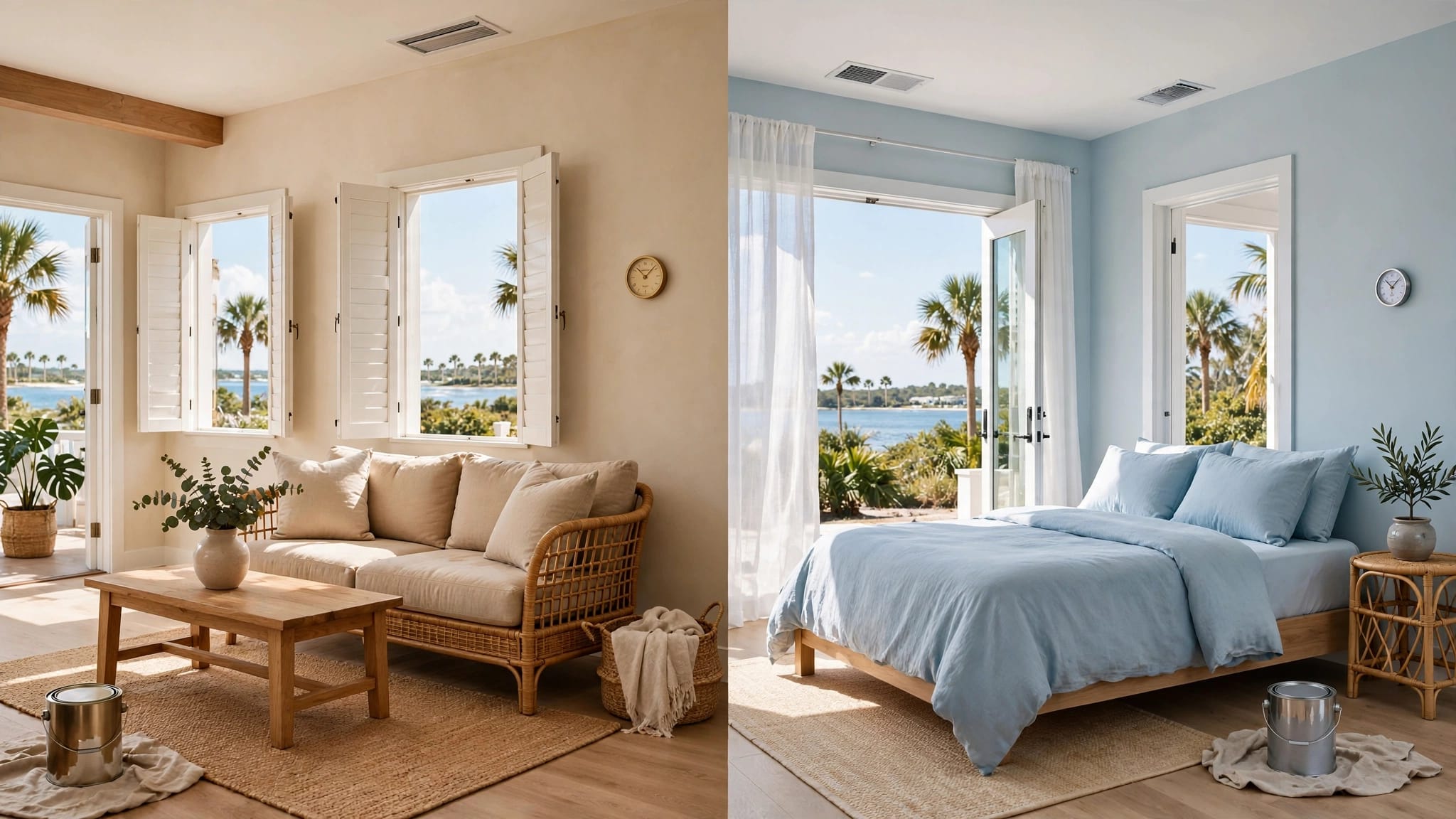
Higher-LRV colors usually include warm whites, creams, pale grays, soft sand tones, and muted coastal greens. These colors often work well on broad stucco or concrete block walls because they look calmer in strong sunlight.
Darker colors absorb more solar energy. They can also show fading, chalking, patching, and surface variation sooner on walls that receive direct sun. Dark colors aren't automatically wrong, but they need careful placement and product selection.
A deep accent may work well on a recessed entry, front door, shutter, or shaded architectural detail. Covering an entire south-facing stucco elevation in that color creates a different maintenance concern.
For more guidance on coordinating walls with warm tile, see these exterior paint colors for Florida homes with red tile roofs.
Why LRV isn't the whole decision
LRV doesn't tell you whether a coating will bond to chalky stucco, resist mildew, handle salt air, or bridge a small crack. It also doesn't account for the roof, nearby landscaping, shade, or the color of surrounding pavers.
Use LRV as an early filter. Then review the wall condition, substrate, exposure, finish, and product requirements before approving a color.
Why Southwest Florida Sun Exposure Matters
A home in Naples, Fort Myers, Cape Coral, Bonita Springs, or Estero can have several different exterior lighting conditions. One side may receive direct afternoon sun while another stays shaded by a lanai, trees, or an adjacent structure.
South and west walls need extra attention
South-facing walls often receive extended sun exposure. West-facing walls receive strong afternoon light, which can make fading and color shifts more visible. Dark reds, deep blues, and rich greens may show wear sooner on these elevations.
The same paint can appear lighter, warmer, or more intense depending on the wall's direction. A color that looks balanced on a shaded front porch may look washed out or overly bright on a west-facing garage wall.
If one elevation receives much more sun than the others, consider testing a lighter body color or reserving darker shades for protected accents. This practical approach supports choosing durable colors for sunny exterior walls.
Humidity, salt, and vegetation change the result
Southwest Florida weather affects both appearance and maintenance. Coastal air can leave salt residue on the finish. Rain and humidity can encourage mildew in shaded areas, beneath soffits, and near dense landscaping. Sprinklers may also leave mineral deposits or keep lower walls wet.
A higher LRV won't solve those problems. The project still needs proper washing, drying, repairs, caulking, and a coating suited to the surface. Trimming plants away from the wall and redirecting sprinklers can help the finish dry more effectively.
LRV Considerations by Exterior Surface
The same color can look different on rough stucco, smooth fiber cement, metal trim, and a front door. Texture changes the way light scatters across the coating, while sheen changes how much reflected light reaches your eye.
A surface-specific plan is more reliable than selecting one paint product for every part of the property.
| Exterior surface | Practical LRV approach | Important follow-up |
|---|---|---|
| Stucco or concrete block | Use lighter or mid-light colors for broad walls | Check repairs, alkalinity, moisture, and masonry compatibility |
| EIFS | Review approved light-reflectance requirements | Follow the EIFS manufacturer's color limits |
| Fiber cement or smooth siding | Compare body color with trim and roof materials | Confirm adhesion, flexibility, and fade resistance |
| Wood and metal details | Reserve stronger colors for smaller areas when possible | Use the correct primer and surface preparation |
| Doors, shutters, and accents | Darker colors can work in protected locations | Match sheen and product to the material |
The main takeaway is that LRV should be reviewed together with the substrate, not separately from it.
Stucco and concrete block
Broad stucco walls often benefit from light neutrals or softened colors that look even across textured surfaces. A rough wall may make a color appear less saturated than it looks on a smooth door.
Before painting, the contractor should check for chalking, mildew, hairline cracks, failed caulk, and previous patching. A color decision made before those issues are addressed may not represent the final appearance.
For full sun, low-luster or satin finishes can balance cleanability with the need to avoid excessive glare. Matte to low-luster finishes may suit shaded or lanai areas, depending on the surface and product instructions.
EIFS has additional requirements
Exterior Insulation and Finish Systems require more care than a simple color choice. Some EIFS manufacturers limit approved colors based on light reflectance because darker colors can increase solar heat absorption and surface movement.
The manufacturer's requirements should control the selection. A contractor should identify the EIFS system, review its approved coating options, and confirm the proposed color before work begins. These EIFS exterior color and coating requirements can affect both residential and commercial projects.
How to Choose an LRV-Friendly Color Palette
A practical Southwest Florida palette usually starts with the parts of the property that won't change. The roof, stone, brick, pavers, gutters, landscaping, and neighboring buildings all influence how the wall color reads.
Warm roofs often pair more naturally with cream, beige, taupe, warm greige, or muted green. A cool gray may work with a darker roof, but it can clash with cream stone or yellowed trim. Hold samples beside fixed materials instead of viewing them across the yard.
Light coastal colors can provide a calm base for homes near the Gulf. Warm whites, sea-glass tones, pale grays, and sun-washed greens are common choices because they stay relatively restrained in bright light. Deeper navy or teal can add contrast on a door or shutter without covering an entire sun-baked wall.
These sun-friendly paint colors for coastal homes are useful starting points, but every property still needs outdoor testing.
Test Exterior Paint in Real Florida Light
Paper chips and digital previews can narrow your options. They can't reproduce your wall texture, changing daylight, surrounding materials, or existing coating.
Apply real samples to more than one wall
Use actual paint on a clean, stable area with the same surface type as the rest of the project. Apply enough coats for full coverage and allow the sample to dry before judging it.
If possible, test the color on a sunny elevation and a shaded elevation. Check it in the morning, around midday, and during late afternoon. Bright midday sun can wash out subtle undertones, while lower-angle light may reveal blue, green, yellow, or red tones.
View the sample from the street, driveway, porch, and nearby rooms. The color may feel different up close than it does across the full facade.
Test the finish with the color
A low-luster wall finish and a semi-gloss door finish won't reflect light in the same way. Sheen can make a color appear brighter or darker, and an overly glossy wall may create uneven glare in strong sun.
Test the proposed sheen where it will actually be used. Compare the sample with the roof, trim, shutters, garage door, landscaping, stone, and pavers. A complete sample process is part of what to expect during a Southwest Florida exterior paint project.
LRV Is Only One Part of Exterior Performance
Choosing a lighter color can support a sensible heat-management plan, but exterior temperature depends on more than paint. Wall orientation, shade, roof exposure, insulation, ventilation, substrate, moisture, and surrounding hardscape also affect conditions at the building.
Durability depends on more than LRV, too. A high-LRV color can still fail early if the wall is dirty, damp, chalky, poorly caulked, or coated with an incompatible product.
Preparation protects the color decision
A sound exterior painting scope should address power washing, mildew treatment when needed, scraping, sanding, caulking, spot priming, repairs, and drying time. Salt, dust, oil, rust, and loose paint can interfere with adhesion.
Stucco, masonry, wood, fiber cement, and metal each need different preparation. Metal may require corrosion control. Porous masonry may need a compatible coating that tolerates the surface and allows appropriate vapor movement. Wood needs attention to moisture and movement.
Choose the coating and sheen for the surface
A color may be suitable for a stucco wall but require a different product on metal trim or a wood door. Ask the contractor to identify the coating system, sheen, and location for each surface.
For most Southwest Florida walls, low-luster or satin finishes can offer a practical balance between appearance and cleaning. Trim, doors, and metal details may need a different sheen. The final recommendation should follow the surface condition and product instructions, not color alone. This guide to choosing paint sheen for Florida exteriors provides a useful comparison.
Planning for HOA and Commercial Approval
Homeowners in Fort Myers and Naples may need written approval before changing an exterior color, even when the new color looks close to the existing one. Read the governing documents before buying paint or scheduling a crew.
Associations may regulate body, trim, door, garage door, shutter, soffit, and accent colors. They may also restrict high-gloss finishes, require exact manufacturer codes, or limit darker colors. Commercial properties may need a written color schedule and surface plan for different walls, doors, metal, and tenant areas.
Submit complete color information
An approval package may include the paint manufacturer, color name, full code, sheen by surface, sample chips, and a simple diagram showing color placement. Some communities also request contractor insurance information, work hours, parking details, and an estimated schedule.
Don't rely on a verbal approval. Keep the written decision with the project records, especially if board members or property managers change.
Allow time for weather and curing
Southwest Florida rain and humidity can affect washing, application, and cure time. A schedule should include preparation and drying, not only the days when paint goes on the wall.
If the contractor proposes a product, color, or sheen substitution, obtain written HOA approval before making the change. A small mid-project adjustment can create a violation or force repainting.
Key Takeaways
- Exterior paint LRV helps compare how much light colors reflect or absorb.
- Higher-LRV colors often suit broad, sunny walls, but they don't guarantee lower temperatures or longer service life.
- South- and west-facing walls deserve extra attention because they receive stronger sun.
- Salt air, rain, humidity, mildew, sprinklers, and vegetation affect the finish.
- Check manufacturer requirements carefully for EIFS and other specialized surfaces.
- Test actual paint in sun and shade, at different times of day, and beside fixed materials.
- Review HOA or commercial approval rules before scheduling exterior work.
- Preparation, substrate compatibility, coating selection, and sheen matter as much as color.
FAQ About Exterior Paint LRV in Southwest Florida
What exterior paint LRV is best for a Florida home?
There isn't one correct LRV for every Florida home. A lighter body color often makes sense for a broad wall exposed to strong sun, while a darker shade may work as a protected accent. The right choice depends on the substrate, exposure, roof, surrounding materials, and coating requirements.
Does a higher LRV guarantee a cooler exterior wall?
No. Higher LRV generally means the color reflects more light than a darker color, but wall temperature also depends on shade, orientation, roofing, insulation, ventilation, substrate, and moisture. LRV is useful for planning, not a guarantee.
Can I use a dark exterior color in Southwest Florida?
You may be able to use one on a door, shutter, recessed entry, or other limited area. Large dark walls absorb more solar energy and may show fading or surface variation sooner. EIFS manufacturers may also restrict darker colors, so verify the system requirements first.
Should I choose paint color or sheen first?
Consider them together. Sheen changes how light reflects from the surface and can alter the apparent color. Test the actual color and intended finish on representative areas before approving the full exterior.
Choose an Exterior Color With the Whole Property in Mind
The best exterior paint LRV decision starts with the wall but doesn't end there. Review the home's exposure, substrate, roof, trim, landscaping, moisture conditions, and community requirements before choosing a color.
A lighter color can be a sensible choice for a hot, sunny elevation, yet the finish will only perform as well as the preparation and coating system beneath it. Test real samples, confirm the written scope, and select a contractor who can connect color planning with Florida-specific surface preparation.
More featured articles...