Choosing Coatings for Florida Industrial Substations
Choose industrial coatings for substations in Florida by matching the system to exposure, substrate, existing finish, and equipment manufacturer specifications. For outdoor steel, a compatible rust-inhibitive primer and UV-resistant finish are often appropriate, but electrical equipment needs additional restrictions.
Salt air and humidity in coastal environments make surface preparation as important as product chemistry. Start with the asset's condition and operating requirements before comparing products or contractor prices.
Key Takeaways
- Specify systems by asset, separating structural steel, galvanized components, aluminum, concrete, and electrical equipment.
- Require measurable preparation, application, curing, and inspection criteria rather than a general promise to remove rust.
- Keep coatings away from electrical interfaces and protected components unless the equipment specification expressly permits application.
Match Substation Coatings to Florida Exposure
Salt, moisture, and sunlight
Coastal salt deposits attract moisture and promote rusting where protective finishes are damaged. Meanwhile, Florida humidity prolongs surface wetness, and intense UV exposure degrades susceptible binders. Temperature fluctuations also stress coatings and joints.
However, distance from the shoreline doesn't fully describe exposure. Wind direction, nearby cooling equipment, chemical emissions, drainage, and sheltered salt-collecting surfaces matter. ISO 12944-2 provides atmospheric corrosivity categories for steel protection; the specification should assign exposure based on site conditions rather than label every Florida installation identically.
Substrate and existing condition
Bare carbon steel, galvanized steel, and aluminum require different preparation and primer choices. Existing coatings add compatibility and adhesion concerns, especially where several maintenance coats have accumulated.
Document corrosion at welds, fasteners, seams, and equipment supports. Deep pitting, section loss, and damaged connections require qualified evaluation before painting. The applied film protects sound material; it can't restore lost structural capacity.
Also record operating temperatures and retained finish condition. These details determine whether localized repairs or broader removal make sense.
Choose Coating Chemistry by Service
A coastal steel system often combines a suitable zinc-rich primer, epoxy intermediate coat, and aliphatic polyurethane finish. Epoxy coatings provide barrier protection, while compatible polyurethane coatings provide UV-resistant exterior finishes. Choose these layers based on substrate, exposure, preparation, operating temperature, manufacturer specifications, and compatibility.
These coating families address different exposure needs.
| Coating family | Practical role | Important limitation |
|---|---|---|
| Epoxy | Barrier protection and chemical resistance | Many formulations chalk under sunlight |
| Aliphatic polyurethane | UV-resistant exterior finish with flexibility | Needs a compatible underlying system |
| Novolac epoxy | Selected aggressive chemical exposures | Resistance depends on chemical concentration and temperature |
| Vinyl ester | Selected corrosive chemicals and extreme-pH service | Requires service-specific formulation and application controls |
For most weather-exposed assets, chemical resistance alone isn't enough. The complete system must also tolerate sunlight, moisture, and the substrate's service conditions.
Separate transformer oil splash, battery-room exposure, and ordinary atmospheric weathering in the specification. Their requirements aren't interchangeable. Likewise, concrete containment surfaces may need separate moisture testing and preparation.
A product's chemical-resistance chart should address the actual substance, concentration, temperature, and contact duration. The resin name alone cannot establish suitability.
Protect Electrical and Thermal Functions
Metal protection and electrical insulation are different requirements. Ordinary industrial paint doesn't establish dielectric performance or authorize coating energized components.
The owner and electrical engineer should define permitted surfaces, shutdown requirements, isolation, and access restrictions. Qualified electrical personnel must control electrical hazards before application crews begin work.
The work scope should protect grounding and bonding interfaces, contacts, terminals, bushings, insulators, vents, operating mechanisms, and identification plates. Overspray and abrasive dust also require containment.
Transformer tanks and radiators need manufacturer-approved finish practices because thickness, color, and finish can affect thermal performance. A lighter color may reduce solar heat absorption, but color alone doesn't establish suitability.
AAMA weathering performance does not certify electrical insulation, grounding continuity, or transformer cooling performance.
Avoid broad language such as "paint all exposed metal." A surface-by-surface finish and masking schedule gives contractors a safer, clearer scope.
Understand Factory-Applied Aluminum Finishes
Product names and published ratings
Factory fluoropolymer finishes can suit new aluminum fabrications, but their architectural ratings don't qualify them for every substation component.
Poma describes Coastal Powder Coatings, adjacent to its fabrication plant, as the only facility of its kind in South and Central Florida. Its profile names PPG Kynar 500 XL as a three-coat system with strong UV protection and coastal warranty terms of 10 to 20 years. It also identifies Sherwin-Williams SHER-NAR 500 XL among the systems Coastal is approved to apply.
Those published warranty descriptions aren't universal guarantees for electrical equipment or field repairs.
AAMA performance versus service life
Coastal Super-Durable carries a published five-year durability rating and references AAMA 2604-05. Poma describes high-performance resin options with 10- to 15-year ratings, including Coastal Fluoropolymer Thermo Setting Resin with a 15-year rating and AAMA 2605-05 performance.
However, Coastal's own published fluoropolymer ratings differ: five years for a single-coat system and ten for two coats. These claims describe different published system ratings, not one interchangeable warranty.
AAMA 2604 and 2605 address architectural aluminum finishes. Their South Florida weathering requirements commonly reference five and ten years, respectively. Test duration isn't guaranteed service life , and the "-05" designations identify older editions.
Account for Aluminum Pretreatment and Shop Limits
Poma's process description begins with a six-stage chrome conversion pretreatment as part of aluminum pretreatment. The process deposits a chrome-phosphate conversion layer on aluminum. Cleaning and etching prepare the surface, while the conversion layer supports adhesion and corrosion resistance.
Its published process uses rinse water treated through reverse osmosis, ultraviolet light, and multistage filtration. These controlled steps illustrate why specifying powder chemistry alone leaves out much of the system.
Poma also describes a fluoropolymer option applied in one coat compared with a two-coat PVDF process. High-chromatic colors may need additional coats. That statement applies to the described product process, not every fluoropolymer finish.
Published equipment limits include:
- A conveyor accommodating parts up to 24 feet long and 8 feet high, with returns up to 5 feet.
- A second track handling products up to 43 feet long and 9 feet high.
- A drying oven with six-minute convection circulation and a bake oven capable of 500°F.
These are equipment capabilities, not universal curing instructions. Factory baking suits eligible fabricated components, not assembled electrical equipment with temperature-sensitive parts.
A manufacturing facility with an adjacent painting facility can reduce transport and repeated handling for eligible parts. That logistical advantage doesn't replace substrate-specific qualification or make a shop finish suitable for field application.
For fabricated components, verify that E.S.P. electrostatic spray painting is compatible with the substrate, finish, curing process, and manufacturer requirements. This method isn't automatically interchangeable with powder application.
Specify Preparation and Florida Application Conditions
Define cleanliness and surface profile
A proposal should identify surface preparation standards and acceptance criteria rather than promise "rust removal." SSPC-SP 10/NACE No. 2 defines near-white blast cleaning of steel; SSPC-SP 6/NACE No. 3 defines commercial blast cleaning. Neither is automatically required for every asset.
Shot blasting, other abrasive blasting, or grinding may be appropriate within the specified system. Galvanized steel and aluminum need substrate-compatible treatment, not an assumption that aggressive steel preparation applies everywhere.
Remove oil, salts, dust, and failed finish. Blasting doesn't eliminate the need for contamination removal. Include edge preparation, weld treatment, and stripe coating where specified.
Measure conditions through application and cure
Record air temperature, surface temperature, relative humidity, and dew point. A common guideline keeps the substrate at least 5°F above dew point, but manufacturer requirements and project specifications govern.
Florida rain and evening condensation can interrupt both application and curing. The work window must accommodate preparation, recoating, and initial cure, not merely spraying time.
Also distinguish condensation from moisture inside concrete. Acceptable dew point readings don't prove a containment slab is dry enough for its specified coating.
Compare Contractor Proposals on the Complete Scope
Compare bids using the same preparation standard and specified system, access restrictions, and inspection requirements. Material price alone misses major costs such as containment, outage coordination, equipment masking, repairs to corroded steel, and weather delays.
Require product names, dry-film thickness by coat, recoat windows, cure requirements, repair procedures, and acceptance criteria. Dry-film thickness measurements can follow ASTM D7091, with SSPC-PA 2 where the specification requires it.
Worker protection must address applicable OSHA requirements, including electrical hazards, respiratory protection, access, and potentially hazardous existing coatings. Environmental planning must address EPA rules, applicable Florida permitting requirements, emissions, debris, and waste handling.
Low-VOC formulations can help meet environmental objectives, but VOC content alone doesn't establish compliance or coating performance. Likewise, FDA-related requirements concern applicable food-processing operations, not substations by default. Intumescent or fire-retardant coatings belong only where the required fire-protection design calls for them.
Warehouse painting experience can show access and application capability, but it doesn't replace substation-specific electrical coordination or equipment requirements. Our industrial painting services include coating selection support for Southwest Florida facilities. For substation work, the coating scope must remain coordinated with the owner's electrical and equipment requirements.
Build Inspection and Maintenance Into the Specification
Require inspection records before accepting the work. Useful documentation includes preparation results, surface profile, environmental readings, product batches, application dates, thickness measurements, repairs, and final findings.
Our industrial coating inspection checklist outlines condition checks and documentation for regional facilities. Within a substation, qualified personnel must control access and inspection methods.
After installation, establish a condition-based schedule that accounts for exposure and criticality. Include additional inspections after major storms and repairs. Look for blistering, rust staining, peeling, chalking, and damage around seams, fasteners, supports, and drainage paths.
Salt removal and cleaning require equipment-approved methods and electrical safety controls. Routine pressure washing around substation equipment can introduce unacceptable risks.
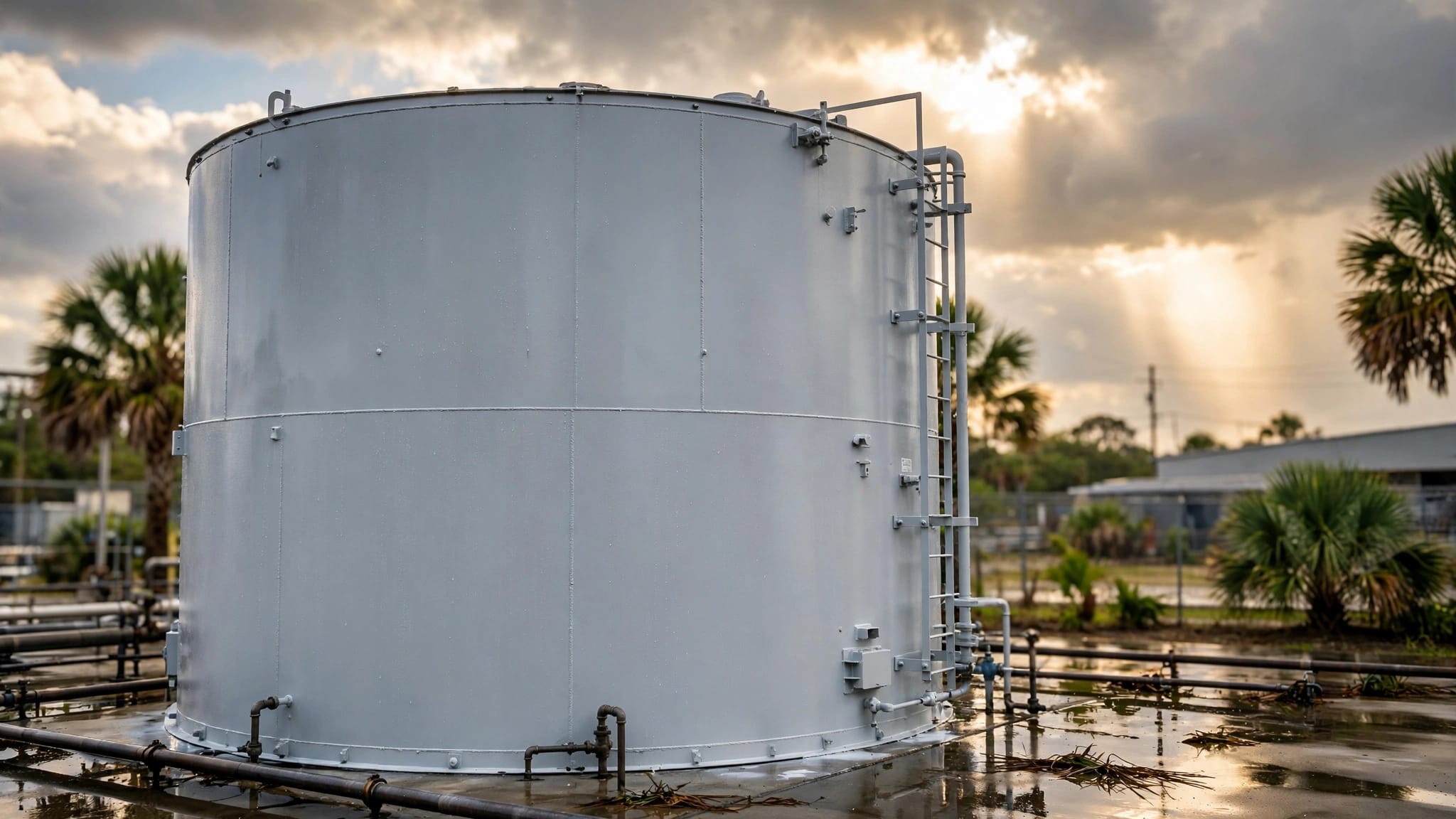
For associated storage assets, our Florida tank recoating guide addresses exterior coating considerations separately. Tank requirements shouldn't automatically become transformer specifications.
Repair isolated defects before corrosion spreads beneath otherwise sound film. Keep photographs and repair histories tied to asset numbers so future decisions reflect observed deterioration rather than an assumed repainting interval.
Frequently Asked Questions
What is dielectric powder coating?
Dielectric powder coating is an insulating finish designed for specified electrical applications. Its performance depends on formulation, thickness, coverage, curing, and testing. Ordinary architectural powder coating isn't automatically dielectric, and a protective finish cannot replace equipment-specific insulation requirements.
Can one coating protect an entire substation?
Usually, several systems are appropriate because substations contain different substrates and service conditions. Structural steel, galvanized hardware, aluminum housings, concrete containment, and electrical equipment shouldn't share one blanket specification. Assign each asset a compatible system and define protected surfaces separately.
Choose a Complete Protective System
Effective substation coatings in Florida depend on matched requirements : exposure, substrate, preparation, application conditions, and manufacturer-approved service limits. A durable-looking finish provides little assurance without documented preparation and inspection.
Compare contractors on the complete scope, including electrical coordination and maintenance records. The strongest specification protects the asset while preserving the functions the substation must perform.
More featured articles...